AI FinOps Is Having Its 2012 Moment
AI FinOps gives engineering and finance a shared way to attribute AI spend, measure cost per outcome, and control usage before the invoice arrives.
In 2012, nobody owned the cloud bill. Engineers spun up instances, finance found out at month-end, and a whole discipline had to be invented to close the gap. AI spend is at that exact point now, except the meter moves per prompt instead of per hour.
The FinOps Foundation's 2026 survey makes the change hard to miss. It reports that 98 percent of FinOps teams now manage AI spend, up from 31 percent two years earlier, and that FinOps for AI is their top priority. That jump is not a victory lap. It is the fire alarm: the bill has become too large to ignore.
AI FinOps is the practical response. It is a way for engineering, product, and finance to share one view of AI cost, connect that cost to the work it produced, and act before a surprise reaches the invoice. It borrows the best parts of cloud FinOps, but it needs a new set of building blocks.
The revenue curve is already ahead of the tooling curve
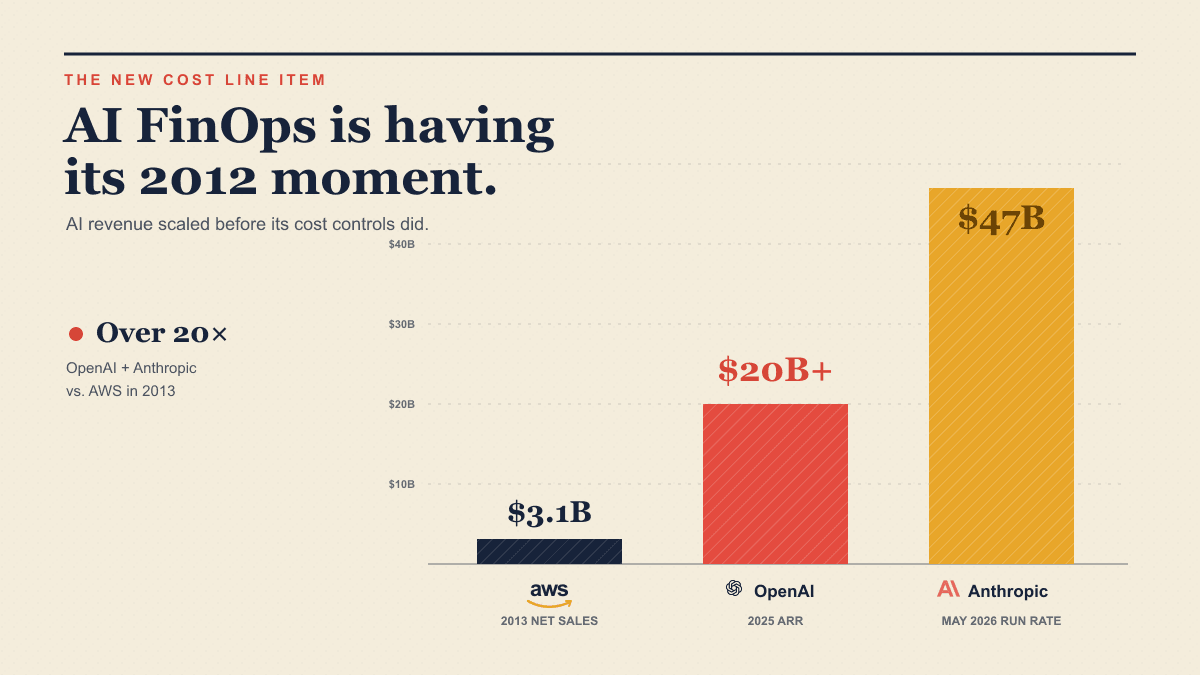
The scale makes the 2012 comparison more urgent. CloudHealth, one of the companies that helped establish cloud financial management, was founded in 2012. Amazon later reported that AWS generated $3.1 billion in net sales in 2013, the earliest year in its first public three-year segment table.
AI providers have already moved far beyond that point. OpenAI reported that its annual recurring revenue grew from $2 billion in 2023 to more than $20 billion in 2025. Anthropic said its run-rate revenue crossed $47 billion in May 2026, less than three years after earning its first dollar of revenue.
AI revenue has already passed the early-cloud scale
Company-reported revenue, USD billions
AWS
2013 · Full-year net sales
OpenAI
2025 · Annual recurring revenue
Anthropic
May 2026 · Run-rate revenue
The reporting bases and dates differ, so this is a scale comparison, not an accounting comparison. OpenAI reported more than $20B; its bar uses $20B as a conservative floor.
These figures are directional, not perfectly comparable. AWS reported full-year net sales, while OpenAI and Anthropic reported annualized run rates at different dates, and model providers can account for partner revenue differently. Even with that caveat, the latest company-reported figures for OpenAI and Anthropic add up to more than $67 billion, over twenty times AWS's disclosed 2013 sales.
Cloud cost management had time to mature alongside the market it served. AI FinOps is being asked to catch up after the market is already measured in tens of billions of dollars. As AI becomes a larger share of software budgets, the same questions that built cloud FinOps will become unavoidable: who spent the money, what created the usage, and what business result did it buy?
The cloud playbook only gets us halfway
Early cloud bills were hard to explain because infrastructure was easy to create and hard to trace. A developer could start a resource in seconds. Weeks later, finance received a total with no useful owner attached. Tags, accounts, budgets, showback, and unit economics emerged because teams needed a common language.
AI repeats that pattern at a faster speed. One product action can trigger a prompt, several tool calls, a retry, and a second model that checks the first model's answer. Two requests that look identical to a customer can have very different costs. A model switch can change both the rate and the number of tokens consumed.
Traditional cloud allocation asks which service or account ran a resource. AI allocation also has to ask which customer made the request, which feature served it, which model handled it, and whether the result was useful.
That last question matters. Cost per token is an input metric. Cost per outcome tells you what the input bought.
Before you cap anything, label it
AI FinOps starts with a less glamorous job than cutting spend: making the bill explainable.
Every request should carry the few identifiers your business will need later: customer, product, feature, team, environment, and workflow. A coding assistant may also attach a repository and pull request. A support agent may attach a ticket and resolution status. These fields turn a provider invoice into a business record.
Skip them and you create attribution debt: untagged spend you can never reconstruct with confidence. Provider logs may tell you which model ran, but they will not know why your application called it or which result reached a customer. Trying to join that history after the fact is slow, incomplete, and often impossible.
The cheapest time to add attribution is when the request is created. A small metadata standard now saves a month of spreadsheet archaeology later.
Replace one big number with useful unit costs
A total AI bill answers an accounting question. It does not answer a product question.
Break the total into units people can act on:
- cost per support ticket resolved
- cost per document processed
- cost per customer served
- cost per qualified lead
- cost per merged pull request
A rising total can be healthy if successful outcomes rise faster. A flat total can be bad if quality falls or customers leave. Unit cost gives the number context.
This also changes conversations with finance. Instead of defending a growing invoice with a vague claim about innovation, a product leader can show that an automation costs 42 cents per completed task and saves twelve minutes of staff time. The decision becomes much easier.
Showback first, chargeback when it helps
Showback gives each team a view of the spend it generated without moving money between budgets. It is usually the right first step. People change behavior when they can see that one workflow creates half the bill or that retries doubled after a release.
Chargeback assigns the cost to a team's budget. It can create stronger accountability, but it also creates arguments when attribution is weak. Chargeback cannot rescue shaky data. Let teams see and challenge the numbers through showback first. Move to chargeback only where they genuinely control the cost.
A simple weekly report should answer four questions:
- What did we spend?
- What changed?
- Who or what caused the change?
- What outcome did that spend produce?
If the report cannot answer all four, it is not yet a management tool.
Flat caps punish the wrong people
The tempting response to a fast-growing bill is a blanket limit. Give every engineer the same token allowance. Put the same ceiling on every customer. Route everything to the cheapest model.
Flat caps are easy to administer and often wrong. AI usage tends to be uneven. A small group of power users may produce valuable work with high consumption, while another workflow quietly loops without producing anything. Equal limits treat those cases as equal.
Smart caps use context. They can warn before stopping, vary by team or plan, allow a higher budget for approved workflows, and respond to unusual changes rather than ordinary productive use. They protect the business without turning cost control into a tax on the best use cases.
An operating model for AI FinOps
You do not need a committee of twenty. You need a named owner and a short loop.
Engineering owns request metadata, routing, retries, and model choices. Product defines the outcome and decides what quality is worth. Finance sets guardrails and checks the forecast. One person must own the combined number and have authority to bring those groups together.
Then run the loop weekly:
- review spend and unit-cost trends
- investigate the largest changes
- fix missing attribution
- approve or reject routing changes
- adjust alerts and budgets
- record whether the change improved cost per outcome
A growing bill can be fine. A growing bill that nobody can explain is not.
The tooling half of that loop is now a category in its own right. LLM cost management covers the four jobs it does, and the best LLM cost tracking tools compares how gateways, observability platforms, and cost management tools divide the work between them.
Do the work before the invoice gets big
Cloud FinOps became necessary after years of unmanaged growth. AI teams do not have to wait that long. The request is already the natural point where cost, ownership, and purpose meet. Capture those facts while they still exist.
That is the 2012 moment. The category is forming, the ownership is unsettled, and yesterday's reporting tools are being stretched around a new kind of meter. Teams that build attribution early will be able to price products, defend margins, and invest with confidence. Teams that wait will inherit attribution debt and call it a finance problem.
AI FinOps starts with a plain promise: every dollar should have an owner, a reason, and an outcome. SuperPenguin is built to make those connections without storing prompt content.
Sources
- State of FinOps 2026, FinOps Foundation.
- FinOps Framework: AI, FinOps Foundation.
- A business that scales with the value of intelligence, OpenAI.
- Anthropic raises $65B in Series H funding, Anthropic.
- Amazon 2015 Form 10-K, Amazon.
- Broadcom announces a new CloudHealth experience, Broadcom.
Keep reading
Prices Fell. Your Bill Didn't.
Why are AI costs rising as models get cheaper and more capable? Because better economics invite more features, users, agents, and work.
Reasoning Tokens Are the Invisible Line Item Blowing Up Your Bill
Reasoning token cost can make a lower-priced model more expensive in practice. Here is what teams and AI cost tools should measure next.
Stop Tokenmaxxing. Start Asking What You Got For It.
Jensen Huang wants engineers burning $250k in tokens; Uber blew its annual AI budget by April. The lesson is not to spend more or less, but to stop treating token consumption as the scoreboard and judge AI work by the outcome.