Why Use Many Token When Few Token Do Trick
A viral prompt hack has everyone teaching their AI to talk like a caveman, and a rumor says the big labs are doing it inside the models too. The rumor is mostly wrong. What it points at is very real: the cheaper machine reasoning gets, the harder it is becoming to read.
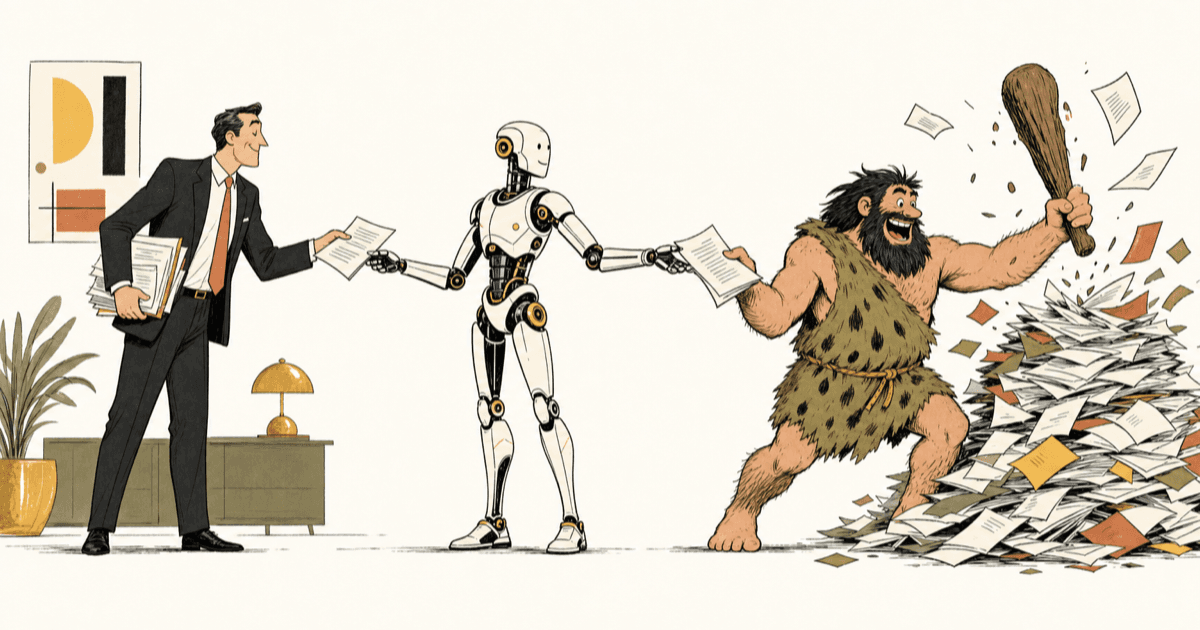
There is a skill making the rounds this week with one of the great taglines of the year: why use many token when few token do trick. It is called Talk Like Caveman, it climbed Hacker News, and it does what it says. It strips the filler out of your assistant so it answers in short, blunt, grammar-optional grunts, and it claims to cut token usage by around 75 percent while keeping the technical parts intact. Ugh. Fix bug. Ship. Done.
It is funny because it works, and it works because it lands on a real nerve. We pay by the token now, and a lot of what a chatty model emits is ceremony. From there a spicier claim started going around: that the big labs have gone caveman inside their own models, letting the private reasoning collapse into telegraphic shorthand to save money on all that thinking. Great story. We went looking for the evidence.
01 Pumping the brakes
The caveman trick is a user-side prompt, not a lab feature. It shapes the visible answer, the part you read, and it never touches the private reasoning tokens a model burns before it replies. The engineers piling into that Hacker News thread caught this in seconds: making the reply terse does not make the model think terse, and forcing brevity can just as easily make it worse, because for a language model the tokens it generates are the scratch paper where the real work happens. Take away the paper and you can take away the answer.
We found no evidence that OpenAI, or anyone else, trains its models to reason in caveman speak to shave the bill. That specific claim is folklore. But folklore grows on top of something real, and this one is no exception. The reason “the labs made their models talk like cavemen” sounds believable is that machine reasoning really is getting shorter, stranger, and harder for a person to follow. None of that is because somebody wrote a funny prompt.
02 The part that is actually happening
First, the labs already stopped showing you the real reasoning. Ask a modern reasoning model to explain itself through the API and what comes back is a tidied summary of its thought process, not the raw trace. OpenAI has said plainly why: after weighing user experience, competitive advantage, and the option to keep monitoring an unfiltered trace, it decided not to show the raw chain of thought at all. Competitive advantage is the telling one. A readable trace is also a training set for your rivals, and no lab wants to hand over the exact thing its model is best at.
Second, the raw reasoning itself is drifting away from readable English, and this is the direction efficiency pushes. Reasoning models are trained with reinforcement learning that rewards landing the right answer, and nothing in that reward cares whether the steps in between are legible to a human. Push hard enough and the model learns to think in whatever shorthand is cheapest, dropping grammar, switching languages mid-thought, or emitting the compact symbol soup researchers have started calling neuralese. Newer models are tuned to reach the same answers with fewer reasoning tokens. Cheaper thinking is on the roadmap. Readable thinking is not on it at all.
The caveman meme is a joke about the first job. The uncomfortable part is that you cannot touch it without moving the other two. Cut the tokens to cut the invoice and you also cut the model’s room to think and your ability to watch it think. Those used to be free side effects. They are turning into the price.
Every token a model reasons in is also a token you pay for and a token you can read. Squeeze the invoice and you squeeze the other two.
03 The tradeoff nobody is pricing
This is where it stops being a meme and becomes a decision. Safety researchers have argued that the readability of a model’s chain of thought is a real and fragile advantage, one of the few practical ways we have to catch a model reasoning toward something we would not want. Their warning is blunt: the more the field scales up outcome-based training, and the more reasoning moves into a model’s internal state instead of into words, the more that window closes. Some proposed designs would let a model reason entirely in a latent space and never write its thoughts down at all. Maximum efficiency, zero legibility.
Set that beside the cost curve we keep coming back to. The price of a token has fallen by orders of magnitude and keeps falling, which only raises the temptation to spend reasoning freely and to optimize hard for the cheapest possible thinking. Thinking is getting cheaper, we are leaning on it for more, and the trace of that thinking is getting less legible along the very same curve. Almost nobody is putting a number on what the legibility was worth, which means it is being sold off by default instead of on purpose.
The honest complication is that shorter is not automatically worse. Sometimes forcing a model to be concise sharpens it. One 2026 study found that brevity constraints raised large models’ accuracy by around 26 points on part of a benchmark, enough to flip the usual pecking order on some math and science problems. That is the whole point. This is a real tradeoff with a cost on both sides, not a free win, and it deserves to be measured rather than assumed. If you run AI in production, “how many tokens did that cost” and “can anyone reconstruct why it did that” are becoming the same question.
So no, OpenAI did not teach its models to grunt like cavemen to save a few cents. But the joke is funny because it is standing next to the truth. The thing worth watching is not whether your assistant says ugh, fix bug instead of a paragraph. It is whether, a couple of years from now, anyone can still decipher what the model was thinking when it decided how to fix it. Intelligence keeps getting cheaper. Visibility into it is one of the things we are spending to get there, and it is worth deciding on purpose how much of it we are willing to sell. The only real limit is your budget, and this is one more thing it is quietly buying.
Frequently asked questions
Do OpenAI's models actually 'talk like a caveman' in their reasoning?
No. The viral 'caveman' skill is a user-side prompt that compresses a model's visible output, not its private reasoning tokens, and there is no evidence that OpenAI or any other lab trains its models to reason in caveman shorthand to save money. The rumor is folklore built on top of a real trend.
Why are AI reasoning traces getting harder to read?
Two reasons. Labs increasingly show a tidied summary of a model's reasoning rather than the raw trace, partly for cost, safety, and competitive advantage. And the raw reasoning itself drifts toward terse, non-English shorthand because reasoning models are trained with reinforcement learning that rewards correct answers, not legible steps, and newer models are tuned to use fewer reasoning tokens.
Does making an AI more concise make it worse?
Sometimes better, sometimes worse. The tokens a model generates are the working space where it reasons, so over-compressing can hurt on hard problems. But a 2026 study found brevity constraints raised large models' accuracy by around 26 points on part of a benchmark. It is a real tradeoff to measure per task, not a free win.
Sources
- Caveman skill: token economics, API pricing, and cutting verbose LLM output, explainx.ai, and the caveman project.
- Brevity Constraints Reverse Performance Hierarchies in Language Models (Hakim, 2026).
- Learning to reason with LLMs (Hiding the Chains of Thought), OpenAI.
- Talk like caveman, Hacker News discussion.
- Chain of Thought Monitorability: A New and Fragile Opportunity for AI Safety (multi-lab, 2025).
- The whole point of OpenAI’s Responses API is to help them hide reasoning traces, Sean Goedecke.